By Mr. Green, Senior Analyst at Charge Cycle
Last Updated: December 2025
I’ll admit it: I miss the noise.
There is something primal about a naturally aspirated internal combustion engine (ICE). It breathes, it vibrates, it screams. For a century, that noise was the soundtrack of freedom. It was the mechanical heartbeat of the industrial revolution.
But as a senior analyst for Charge Cycle, I have to check my nostalgia at the door and stare at the math. And the math is brutal.
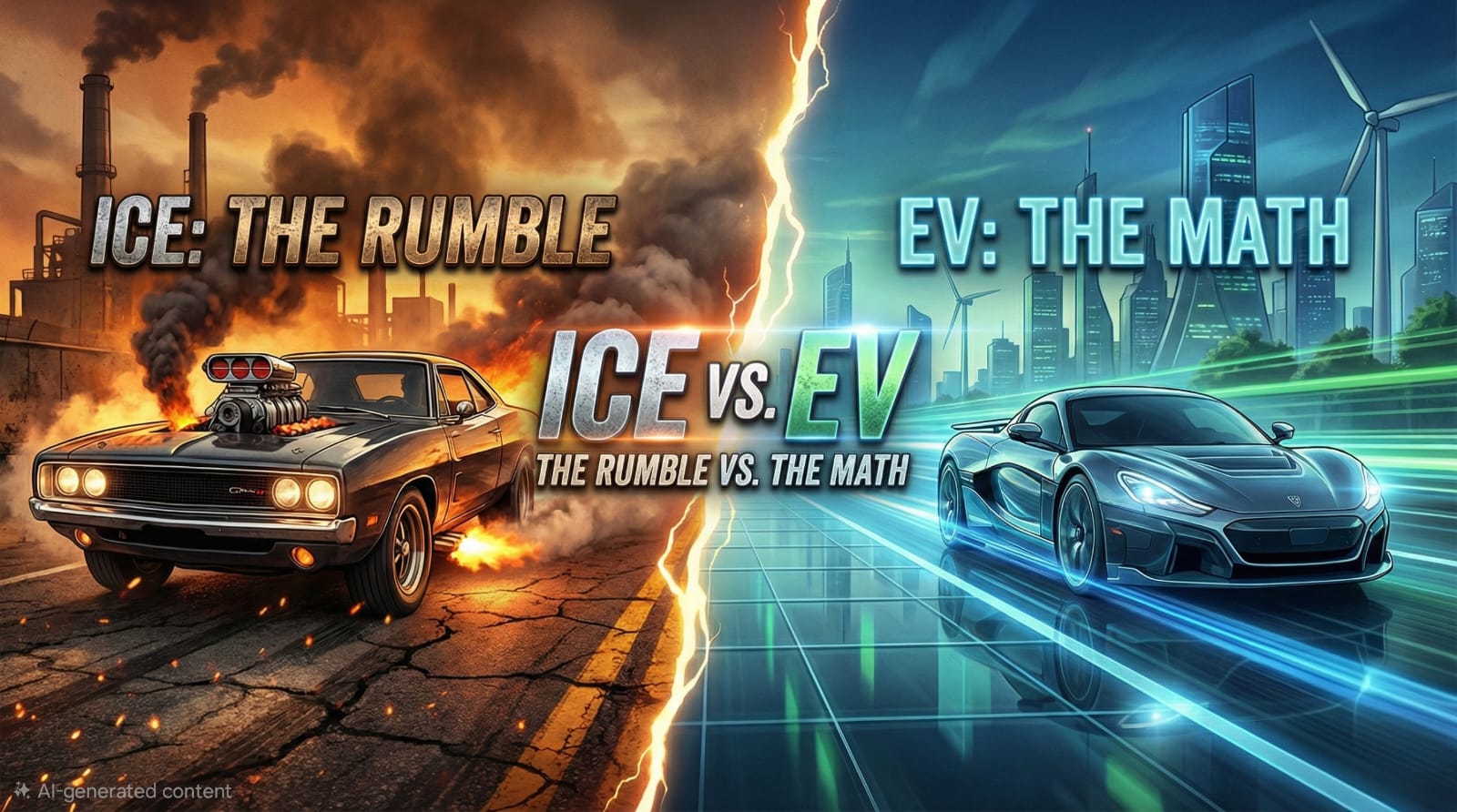
When you strip away the romance, an internal combustion engine is a dinosaur. It is a loud, leaking, heat-generating machine that is shockingly bad at its one job: moving you forward. The debate over ICE vs. EV sustainability isn’t a battle of ideologies anymore; it’s a battle between a romantic past and a ruthlessly efficient future.
Here is the unvarnished reality of what you drive, stripped of marketing fluff and backed by the latest 2024/2025 data from the Union of Concerned Scientists (UCS), the ICCT, and Emissions Analytics.
The Cheat Sheet: ICE vs. EV By The Numbers
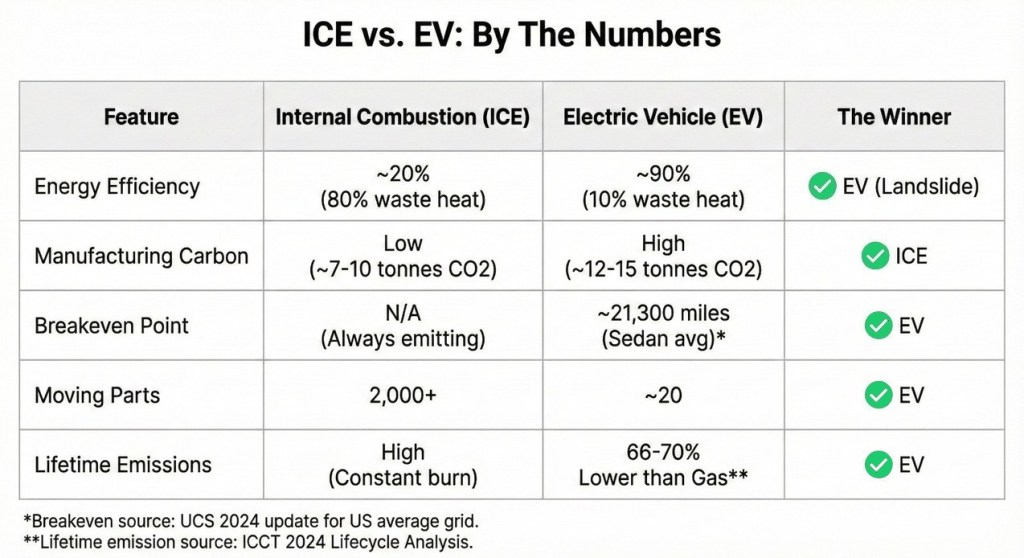
If you are strictly here for the stats, here is the raw data comparison
1. The Inefficiency of “Soul”
Let’s talk about that “soul” car enthusiasts love to defend. In engineering terms, that soul is mostly waste.
A standard gas engine operates at roughly 17-21% thermal efficiency. Think about that for a second. For every $100 you put in the tank, about $80 is set on fire—wasted as heat, noise, and friction. You aren’t paying for transportation; you are paying to heat up the pavement, with a side effect of forward motion.
The Electric Vehicle (EV) is cold and calculated by comparison. It doesn’t care about drama; it cares about physics. EVs convert 85-90% of their grid energy directly to the wheels. There is no explosion, no wasted heat, just instant, silent torque.
From an operational standpoint, the gas car isn’t even in the same league. It’s a typewriter in the age of the laptop. You can love the click-clack of the keys, but don’t pretend it’s better at processing data.
2. The Dirty Secret: The Manufacturing Debt
We need to be honest. If you care about facts, you can’t pretend the EV is an angel sent from heaven. It has a dirty secret that most EV advocates try to hide.
Building an electric car—specifically that 1,000lb slab of lithium-ion battery sitting in the floor—is a dirty, violent business. Digging up lithium, cobalt, and nickel requires massive industrial effort. It leaves scars on the earth.
In a candid Life Cycle Assessment report released by Volvo Cars, the company revealed that manufacturing their C40 Recharge EV generates approximately 70% more greenhouse gas emissions than its gasoline equivalent. We call this the “Carbon Debt.”
If you buy an EV, drive it for one week, and then crush it, you have done more damage to the planet than if you had bought a diesel truck. That is a fact. But cars aren’t built to be crushed in a week. They are built to move.
3. The Breakeven: Where the Math Wins
This is where the EV carbon footprint story flips. Because the EV is so terrifyingly efficient, it starts paying back that carbon debt the moment the wheels turn. It chips away at its deficit with every clean, silent mile.
According to the Union of Concerned Scientists (UCS) 2024 “Driving Cleaner” report, the timeline is shorter than skeptics think:
- The Sedan Scenario: For a standard sedan on the average US grid, the breakeven point is roughly 21,300 miles. That is just under two years of driving for the average American.
- The Truck Scenario: For massive electric trucks (like the F-150 Lightning), the “debt” is larger, but because they replace gas guzzlers that get 15 MPG, the breakeven still happens quickly—often within 17,500 miles.
Once you cross that line? The EV leaves the gas car in the dust. According to the ICCT (International Council on Clean Transportation) 2024 analysis, over a full lifetime, a BEV sedan produces 66% to 70% fewer emissions than a gas car, even accounting for the heavy battery manufacturing.
4. The Grid Myth: “You’re Just Burning Coal!”
I hear this at every car meet I attend. “You aren’t saving the planet, you’re just driving a coal-powered car!”
It’s a catchy line. It’s also wrong.
The UCS tracks this data meticulously. They calculate an “MPG Equivalent” for EVs based on local power grids.
- The Worst Grid: Even in regions heavily reliant on coal, an EV produces emissions equivalent to a gas car getting roughly 40-50 MPG.
- The Average Grid: On the national average US grid, driving an EV is like driving a gas car that gets 91 MPG.
- The Best Grids: In places like Upstate New York or California (high hydro/solar/nuclear), an EV is like driving a gas car that gets 200+ MPG.
But here is the real kicker: The ICE car has hit its peak. A gas engine bought today will never get cleaner. In ten years, it will burn the same dirty fuel it burns today. An EV gets cleaner as the grid gets cleaner. Your EV effectively upgrades its own fuel source while it sits in your driveway.
5. The Devil’s Advocate: The Tire Problem
I promised you honesty, so here is a piece of data most EV blogs ignore. While EVs eliminate exhaust emissions, they may increase non-exhaust emissions.
EVs are heavy. A battery pack can add 1,000+ lbs to the vehicle. That weight shreds tires.
According to independent testing by Emissions Analytics, tire wear pollution can be over 1,000 times higher by mass than tailpipe exhaust particles. In a direct comparison between a Tesla Model Y and a Kia Niro Hybrid, the heavier Tesla produced 26% more tire wear emissions.
Does this negate the climate benefits? No. CO2 is the global climate killer, and EVs slash CO2 by huge margins. But if we are talking about local particulate pollution (the air you breathe on the sidewalk), the tire dust issue is a real engineering challenge. It’s the one area where the “lightness” of a gas car still holds a slight advantage, and it’s something tire manufacturers are scrambling to solve with harder compounds.
6. The Financial Truth: Maintenance and Ownership
While we are discussing sustainability, we must discuss the sustainability of your wallet.
An internal combustion engine has over 2,000 moving parts. It has spark plugs, transmission fluid, oil filters, timing belts, alternators, and exhaust systems. All of these fail. All of these cost money.
An EV drivetrain has roughly 20 moving parts.
- No oil changes.
- No spark plugs.
- No transmission fluid to flush.
- Regenerative braking means brake pads can last 100,000 miles.
A Consumer Reports study confirmed that EV owners spend 50% less on maintenance and repair over the life of the vehicle compared to gas car owners. You aren’t just saving the atmosphere; you’re saving hours of your life sitting in a dealership waiting room reading three-year-old magazines.
7. The Battery Panic: “It’ll Die in 5 Years”
This is the last refuge of the skeptic. “What about when the battery dies and costs $15,000 to replace?”
Data from millions of EVs on the road tells a different story. Modern thermal management systems mean batteries aren’t dying; they are degrading gracefully.
According to an extensive 2024 analysis of 6,000 electric vehicles by telematics firm Geotab, EV batteries degrade at an average rate of roughly 1.8% per year. This data suggests that for many drivers, the battery will outlast the vehicle itself. The chassis will likely rust out before the battery fails completely.
And when they do die? They aren’t trash. They are gold mines. Recycling firms like Redwood Materials report that their process can recover up to 95% of critical minerals—such as lithium, cobalt, and nickel—returning them to the supply chain to build the next generation of cars.
The Verdict: Evolution, Not Ideology
We still have work to do. We need to clean up the mining supply chain, and we need to ensure Charge Cycle continues to push for transparent recycling data. The tire wear issue is real, and the grid needs to get greener.
But let’s be clear: The rumble of the engine was the sound of the 20th century. It was the sound of inefficiency. The silence of the EV isn’t a lack of soul—it’s the sound of a machine that doesn’t need to shout to get the job done.
If you love cars, you can mourn the noise. I certainly do. But if you respect the engineering and the road we’re driving on, the electric switch isn’t a choice. It’s an evolution.
Legal & Reference Disclaimers
1. No Professional or Financial Advice
The information provided in this article, including but not limited to data regarding vehicle costs, maintenance savings, and battery degradation, is for general informational and educational purposes only. It does not constitute professional financial, investment, or legal advice. The author and publisher are not certified financial advisors or automotive engineers. Any decisions made based on this information are made strictly at your own risk. You should consult with a qualified professional before making any significant financial purchasing decisions.
2. Accuracy of Information
While every effort has been made to ensure the accuracy of the data presented (citing 2024/2025 reports from the UCS, ICCT, Geotab, and others), the automotive industry is fast-evolving. The publisher makes no representations or warranties of any kind, express or implied, about the completeness, accuracy, reliability, suitability, or availability of the information contained herein. Any reliance you place on such information is therefore strictly at your own risk.
3. Copyright & Fair Use Notice
This article may contain references to and data from copyrighted material, the use of which has not always been specifically authorized by the copyright owner. This material is made available for the purpose of criticism, comment, news reporting, teaching, scholarship, and research. We believe this constitutes a “fair use” of any such copyrighted material as provided for in Section 107 of the US Copyright Act. All trademarks and data sources (including Volvo, Tesla, Geotab, UCS, ICCT, Consumer Reports, Emissions Analytics) remain the property of their respective owners and are cited here for educational analysis only.
4. Limitation of Liability
In no event will the author, publisher, or Charge Cycle be liable for any loss or damage including without limitation, indirect or consequential loss or damage, or any loss or damage whatsoever arising from loss of data or profits arising out of, or in connection with, the use of this article.